Showing posts with label Quotes. Show all posts

Wednesday, October 25, 2023

What the PKM? --- Second Brain or Cyber Headache?

Excerpt from Four Talks exhibition at Hirshhorn Museum
of Modern Art, Washington DC [photo B.D. Matt]


My agonizing re-appraisal of personal knowledge management (PKM) was prompted by a change of life circumstances combined with upgrade of computer and cellular phone. While I was comfortable with my prior customary operating procedure, I suspected that I was not better exploiting capabilities at my finger tips.  Following the advice of Tiago Forte, I discerned my PKM style(s), what features were important to me, evaluated my prior methods and was open to considering alternatives. Alas, this was not an simple choice. And to complicate matters, social media influencers demonstrating their application of choice often trash talked the alternative.

I was accustomed to using several unconnected software to manage my personal knowledge.  I heavily used Microsoft OneNotes for digital notetaking and some web capture.  For the family digital calendar, I used Google Calendar.  I used various software for word processing, email clients and graphics capture.  Previously, I had not done daily journaling even for memorializing activities.  Circumstances and deficient training certainly caused me to not better utilize the resources.  I did not have a task manager.   However, some things needed to change for me.

After finishing an intense six month IT curriculum, I needed to seriously study for certification while also getting hands on professional experience.  This definitely called for task management, calendars and notes that are mobile but would enhance linkages.   I had sporadically  used The Brain mind mapping,  but I had old versions which were locked to one host.  I knew that new versions could have cloud capabilities and could act as a PKM, but that was a significant yearly expense.  Still, I was willing to try new versions of The Brain but administrative difficulties caused a delay in upgrading.  So I looked to other options for a second brain.  And what a cyber-headache that produced.

Personal Knowledge Management applications seem to be the rage of productive millennials. That market seems to want to do data dumps and have one app to essentially rule all of the data. But popular PKMs use different organizational schemes, such as: hierarchical (The Brain), files and databases (Notions), object based (Capacities), “Electron” (Obsidian), Office adjunct (OneNotes) et ali.  Consequentially, these PKMs seem optimized to different audiences. 

Marketing PKMs also shows the changes in IT.  The major newcomer notetaking apps (Notions, Obsidian and Capacities) are freemium apps, which is free for personal use but subscription for pro features.  Rather than dropping a load of money on advertising and traditional market presence, this shareware is looking to hook personal consumers with shareware and betting that it becomes so essential that their businesses need to subscribe for the premium level.  Apparently, Notions is well position for team collaboration.

Something to consider when choosing PKMs is the level of freedom within an app and the learning/setup curve.    Both Notions and Obsidian start with a blank slate so a user’s experience on the app can be highly personalized and augmented with plug in apps.  The downside of this freedom is that mastering the PKM can be complicated.  Some users gave the impression that they spent significant time getting the aesthetic right (for them) instead of concentrating on knowledge linkage.

Generally, my PKM style is “librarian” with a elements of “student”. My use case will still entail several software applications.  It has been a struggle to get my spouse accustomed to having a joint household calendar (even though I am the one updating it) so it is dubious that I would have buy in for a new system.   Although PKMs do have elements of word processing (although some may  require Markup for text augmentations), it may work for note taking but for me lacks on composition.  Hence I suspect that I will use my traditional office/word processing type software.  

I see great potential using a PKM for personal task management, but it is important that this information is available for “out of pocket” use (but not necessarily for mobile apps). I am gladdened to know several apps that I am evaluating have web based components–but I will need to be mindful about data security and confidentiality for some topics. Most of the PKMs invite vigorous web capture. Experimentation and experience will be instructive.

Generally, I appreciate the freedom to personalize, but surveying Notions and Obsidian, setup and optimization look like a major time suck.  I will try Notions as it is touted for business and team collaboration but also for the IT cert study project.   I find Capacities PKM to be easy for daily journaling and proto-“Rolodex” (still remember those?) management. I hope to try updated versions of TheBrain to discover if Mind Mapping would be a good second brain for PKM productivity. 

A sagacious suggestion from Tiago Forte which I will take to heart is to commit to apps for a month, even if they are the wrong ones --as a little progress (and wisdom) is better than stillborn trials.  So perhaps in a month I will for know which PKMs I should be thankful and those who might are just cyber headache turkies for me. 


Thursday, April 12, 2018

Mark Zuckerberg = Mr. Data Accumulator?

Facebook CEO Mark Zuckerberg as Mr. Data Accumulator

Mark Zuckerberg, the 33 year old founder and CEO of Facebook, has developed a reputation of being stiff when forced to present himself as a typical corporate executive.

In order to prepare for the ten hours of questioning on Capitol Hill concerning data proliferation and privacy concerns in social media, Zuckerberg was prepped by K Street public relations people to look professional and less robotic.  


Alas, that effort was only partially  effective.   Zuckerbook lost his typical grey hoodie for a suit which helped.  But his scripted replies  seemed synthetic and akin to an android.  So much so, wags wondered if Mark Zuckerberg ought to be called Mr. Data Accumulator, an estranged relation of Data from Star Trek The Next Generation.


Wednesday, April 11, 2018

Diamond and Silk on Social Media Censorship

Diamond and Silk on cyber censorship on Facebook

Prominent conservative voices in social media, such as Diamond and Silk and Dan Bongino, have vociferously voiced outrage that Big Internet has banned them as being unsafe for the social media  community because of their outspoken ideological opinions. This parallels YouTube demonetizing many of Dennis Prager's popular Prager U videos because the conservative views expressed did not sync with the progressive views of their internet overlords. And Twitter is infamous for shadow banning conservatives, even Senator Ted Cruz, without recourse or equal application against outrageous leftist Twits.

Diamond and Silk, who gained fame through their vigorous defense of then Presidential candidate Donald Trump during the 2016 campaign, did not silently take this rough trade from Facebook. On Fox and Friends, Diamond and Silk postulated that Mark Zuckerberg needed to "[S]uck it up, buttercup" and accept diverse viewpoints and freedom of speech on its social network, just as the small Indiana pizzeria would be forced to cater a same-sex wedding despite their religious objections to the ceremony.


Alas, Diamond and Silk have a weak case in a court of law.  Without meandering into the details of RFRA and First Amendment religious liberty, same-sex marriage proponents could point to civil rights legislation which the Supreme Court in Obergefell v. Harris claim a right to dignity for that class.  What protected class can Diamond and Silk rightfully claim against Facebook?

However, in the court of public opinion, Facebook engaging in ideological viewpoint discrimination could be a compelling case for action.  Does MySpace mean anything to Mark Zuckerberg?  That was a social media precursor to Facebook, but when it stopped being cool, it became ghost of itself and a dark web conduit.  Facebook is much bigger and is receiving congressional scrutiny.  Between viewpoint discrimination and revelations of data mining, shareholders should be concerned if Facebook were to become a fraction of its former self.

Facebook has ceased to be a mainly youth oriented site.  Adults may well chafe at having their lives data sold by the social media company.  But for motivated conservatives, this cyber censorship may well have this active demographic find alternatives to speak freely, like on GAB.


Ted Cruz on Social Media Censorship

Senator Ted Cruz invigilates Facebook CEO Mark Zuckerberg on social media censorship against conservatives


Mark Zuckerberg on Hate Speech on Facebook

Facebook CEO Mark Zuckerberg testifies about hate speech before the US Senate


Friday, January 27, 2017

Gabbing about the Capricious Cupertino Walled Garden of Apple

GAB CEO Andrew Torba on Apple App Vetting


Gab is a new micoblogging site which was started in the summer of 2016 as conservative voices experienced cyber-censorship about content from social media giants such as Facebook and Twitter.  Gab wants to create a cyber community which users can speak freely and exercise their own judgment to filter content. 

Gab started with a beta platform geared towards personal computers.  However, since the growth in social media is associated with mobile internet applications, Gab has sought to get approval from Apple to have their app approved to be available in Apple app store.

Because Gab encourages members to #SpeakFreely, they do not want to censor content created by Gab users, as long it conforms to US law and the Constitution regarding obscenity and pornography.  In rare instances, the Gab platform would allow for legal pornography as long as it was tagged #NSFW (not safe for work).  But this loophole created the first objection for the Apple App Review team.  To resolve this, Gab linked their EULA agreement, albeit outside of the app.  The allowed for the second rejection, which was easily abated. 

What has raised eyebrows is the tardy and hypocritical third rejection by the app team. Ordinarily, apps are evaluated within 24 hours.  For Gab's third app submission, it took 17 days. In addition, it was rejected on the grounds that "We found references to religion, race, gender, sexual orientation, or other targeted groups that could be offensive to many users."


So Gab is supposed to play nanny to user epithets and ideas which an aggrieved internet denizen could find offensive.  But Gab allows its users to filter out content which they do not want to see, but the powers that be in Cupertino do not want their i-Phone/i-Pad users to be scandalized by material in Gab (which they could filter out themselves).  

Is the same stringent Cupertino standard applied to Madonna's post Women's March musings?  

Wonder why?  Is Twitter going to have their app taken away for the rude ravings of an aged Material Girl who creates controversy on social media to seem contemporary?

Gab CEO Andrew Torba wonders if the third rejection of Gab's app was timed to coincide with President Trump's first full day in office and was meant to sent a message.  Torba asserted

"This clear double standard against us is potentially politically motivated and clearly targeted. When you actively search for something on a user generated website, chances are you're going to find what you are looking for."


Progressives sought to kill Gab by claiming that it was only for the alt-right and that it lacked diversity, which fails when one considers that Gabs leadership team is comprised of an American Christian, a Turkish Muslim Kurd and an Indian Hindu.  Since the slimming was unsuccessful, it seems that progressive companies are seeking to deny Gab from tools to grow their user base by any means necessary.

With the shadow-blocking and capricious shunnings by big social media, those who want to share opinions which challenge the standard assumptions of progressive elites, they may look to social media alternatives such as Gab.  Alas, Apple continues to make access restricted inside the walled garden

Monday, January 23, 2017

President Trump to Name Net Neutrality Critic Ajit Pai as FCC Chair

[N.B. This article was originally published February 10, 2015 on DistrictofCalamity.com ]


Ajit Pai, a Republican member of the Federal Communications Commission, has become outspoken in his objections to the political imposition of Net Neutrality by what is supposed to be an independent Federal commission.


Commissioner Pai noted that: “It’s no wonder that net neutrality proponents are already bragging that it will turn the FCC into the “Department of the Internet. For that reason, if you like dealing with the IRS, you are going to love the President’s plan." 

Many progressives have rallied around the concept of Net Neutrality thinking that it is hurting corporations and encouraging competition.  What Commissioner Pai points out is that applying Title II regulation to the internet, which was designed for railroads and Ma Bell, will stifle competition and favor behemoth businesses because of the regulatory burdens.

Congressional critics such as Senator Ted Cruz (R-TX) have likened Net Neutrality as being Obamacare for the Internet, regulations sold to lower prices and improve delivery but which in reality do the opposite while making Uncle Sam the undisputed middle man.

Another alarming feature of such broad regulation by the FCC is the relative obscurity in which the rules are being cobbled together.  President Obama pressured the FCC in November 2014 about Net Neutrality.  Chairman Tom Wheeler, who had been a big Obama fundraiser, is complying but promises to make some changes in Title II to make it better.  Oh, so a regulatory schemata which was drawn up in 14 can be tweaked to apply to the internet age.  Right. FCC Commissioner Mike O'Reilly warned the public about the dangers of forbearance as applied to Title II Common Carriers. 

There is the larger issue, however, about whether Congress ceded its legislative mantle to the FCC to strictly regulate the internet. If we hold fast to living in a constitutional democratic Republic, shouldn't our elected representatives, not bureaucrats who are unaccountable to the people (or for that matter Men in Black) be crafting such momentous law?

UPDATE 01/23/2017  President Trump is poised to name Ajit Pai as Chairman of the FCC, replacing Democrat activist FCC Chair Tom Wheeler.  Pai has been a critic of the Commission's impetus to impose net neutrality and thereby expand the FCC's role into regulating the Internet. 

Thursday, October 15, 2015

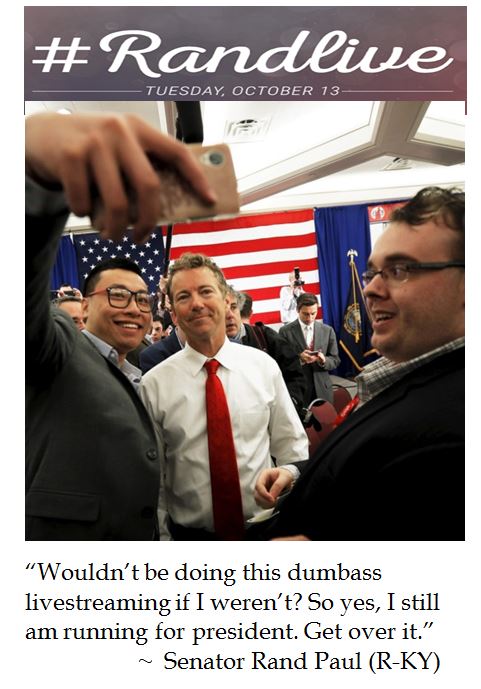
Geek Gaffes Mar #RandLive

Rand Paul on Livestream

One of the most precipitous declines in the race for the 2016 Republican Presidential nomination has been Senator Rand Paul (R-KY).  Last year, the libertarian leaning Senator Paul was considered to be a top contender.  But Paul’s campaign has faded to the point of where he may not have the 2.5% support to qualify for the big stage for the third GOP debate required by CNBC.

Senator Paul wanted to do something different to attract attention, generate enthusiasm among young voters and distinguish himself.  So the Paul campaign arranged for the candidate to LiveStream a day in the life.  This was a thrifty way to shine a spotlight on the candidate, leverage new media to political advantage and reinforce his brand of being a different kind of Republican.

Well, timing is everything. Tuesday October 13th was the date chosen for #RandLive.  From the superstitious side of things, the Spanish consider Martes el trece to be a day of bad luck (akin to America’s Friday the 13th).  On the more calculating side, that was the day of the first Democrat Debate so Rand was scheduling a stunt that would not draw a whole lot of attention.

Perhaps it was lucky that #RandLive did not get much time in the spotlight.  Senator Paul was scheduled to visit five college campus events in Iowa that day.  But technical difficulties interfered with much of the livestreaming, so diehard Rand-ians were left staring at a test pattern for much of the day.  These cyber glitches were unfortunate but not unforgivable as it is challenging to introduce new technology into the field of national political campaigns.

What was more egregious was Senator Paul’s unscripted answers to Google questions.  The third most popular question was “Are you still campaigning Senator Paul?”.  The freshman Senator from Kentucky gave a sarcastic and supercilious unscripted answer.


So much for appealing to the youth vote when you denounce the platform itself.  Moreover, calling it “dumbassed” shows that it was a feign and not really reflecting the candidate’s true disposition.

Other hopefuls used social media on that day to varying effects.  Both former Governor Mike Huckabee (R-AR) and Donald Trump live-tweeted during the Democrat Debate.  It looked like “the Huckster” slinged up cornpone and canned ham in his replies, while “the Donald” delivered authentic raw meat which underlined his attributes.

While it is questionable if hyping a “Truman Show” for a candidate is wise, it does show innovation.  But if you are on camera 24/7, one slight slip up can ruin years of work. In the film “The Truman Show” (1998), people found that they liked watching Truman because he was natural and likable.   Senator Paul has developed a reputation for being prickly in uncomfortable interviews.  It is telling that Senator Paul noted that you can’t edit that out when it’s being livestreamed.


The tag line from The Truman Show was “How's It Going to End?”.  This may well be the same question that staffers for Rand Paul’s Presidential campaign may be asking.   


Perhaps Senator Paul can take a cue from Truman Burbank. 


Monday, March 30, 2015

Clinton EMails-- Not Just a Technological Glitch

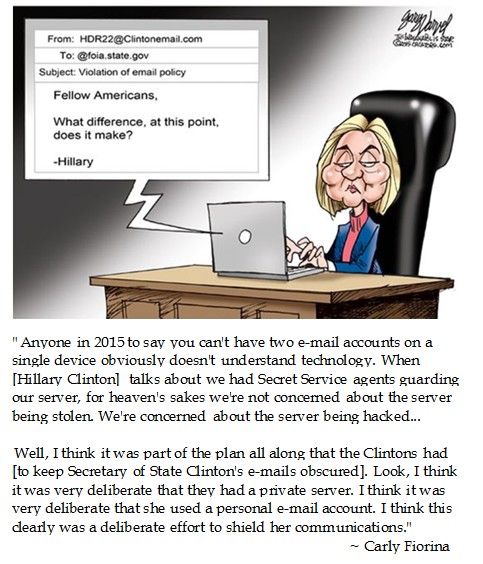
Carly Fiorina impeaches Hillary Clinton's Email Shrouding

MSNBC's Ed Schultz excused Hillary Clinton as being technologically challenged for not understanding that a person can have two email accounts on one device. Perhaps, but not exactly someone who confidently took the bridge to the Twenty First Century.

Nor was the Clintons' insistence on exclusively relying upon their own private email servers for official State Department business a thrifty technology decision. But the fact that these email servers were conveniently wiped clean when under federal scrutiny allows inquiring minds to wonder what electronic communications were being shielded. 


Is Hillary Clinton Just Technologically Challenged?


During Hillary Clinton's brief media appearance at the United Nations, President Obama's first Secretary of State claimed that the kerfluffle concerning Hillary's emails stemmed from the fact that she did not want to carry two smartphones to have two separate email accounts. 

Syncophants in the Lamestream Media, like MSNBC's Ed Schultz, sought to sympathize with Hillary's alibi by suggesting that older people are overwhelmed by technology.


The problem is that but a fortnight ago, Hillary Clinton admitted that she now  carries both an iPhone as well as a Blackberry.  So Special Ed's technologically challenged excuse both rings false as well as suggesting that the 67 year old Mrs, Clinton is not quite with it.

Hillary's assertion about not being able to have two email accounts on a smartphone seems silly to most Americans.  Of course, the matter is not the technological capability but control.  Personal emails on a work issued handset becomes the employer's property.  This is why many people dual fist cell phones. For federal functionaries, the standard was a secure phone provided by the government and an unsecure phone for personal emails. That is an inconvenient truth for Madam Secretary Clinton.

But how can Hillary plausibly posit being technologically challenged when the domain Clintonemail.com was established the day Mrs. Clinton's confirmation hearings for Secretary of State began in the Senate in 2009.  That sounds kind of suspicious for an official who is uncomfortable with technology.

As Mrs. Clinton questionably claimed that she had adhered to all controlling legal authority on preserving federal records, Hillary refused to surrender the server to an independent authority to vet the scrubbed email account as it contained emails from her and President Clinton.

While this press availability was meant to tamp down a scandal which was obscuring positive earned media for the Hillary 2016 proto-campaign. But the event may have multiplied the questions among ordinary Americans and intensified the political and legal pressures associated with Hillary emails.

h/t: Kevin Siers