Wednesday, October 25, 2023

What the PKM? --- Second Brain or Cyber Headache?

Excerpt from Four Talks exhibition at Hirshhorn Museum
of Modern Art, Washington DC [photo B.D. Matt]


My agonizing re-appraisal of personal knowledge management (PKM) was prompted by a change of life circumstances combined with upgrade of computer and cellular phone. While I was comfortable with my prior customary operating procedure, I suspected that I was not better exploiting capabilities at my finger tips.  Following the advice of Tiago Forte, I discerned my PKM style(s), what features were important to me, evaluated my prior methods and was open to considering alternatives. Alas, this was not an simple choice. And to complicate matters, social media influencers demonstrating their application of choice often trash talked the alternative.

I was accustomed to using several unconnected software to manage my personal knowledge.  I heavily used Microsoft OneNotes for digital notetaking and some web capture.  For the family digital calendar, I used Google Calendar.  I used various software for word processing, email clients and graphics capture.  Previously, I had not done daily journaling even for memorializing activities.  Circumstances and deficient training certainly caused me to not better utilize the resources.  I did not have a task manager.   However, some things needed to change for me.

After finishing an intense six month IT curriculum, I needed to seriously study for certification while also getting hands on professional experience.  This definitely called for task management, calendars and notes that are mobile but would enhance linkages.   I had sporadically  used The Brain mind mapping,  but I had old versions which were locked to one host.  I knew that new versions could have cloud capabilities and could act as a PKM, but that was a significant yearly expense.  Still, I was willing to try new versions of The Brain but administrative difficulties caused a delay in upgrading.  So I looked to other options for a second brain.  And what a cyber-headache that produced.

Personal Knowledge Management applications seem to be the rage of productive millennials. That market seems to want to do data dumps and have one app to essentially rule all of the data. But popular PKMs use different organizational schemes, such as: hierarchical (The Brain), files and databases (Notions), object based (Capacities), “Electron” (Obsidian), Office adjunct (OneNotes) et ali.  Consequentially, these PKMs seem optimized to different audiences. 

Marketing PKMs also shows the changes in IT.  The major newcomer notetaking apps (Notions, Obsidian and Capacities) are freemium apps, which is free for personal use but subscription for pro features.  Rather than dropping a load of money on advertising and traditional market presence, this shareware is looking to hook personal consumers with shareware and betting that it becomes so essential that their businesses need to subscribe for the premium level.  Apparently, Notions is well position for team collaboration.

Something to consider when choosing PKMs is the level of freedom within an app and the learning/setup curve.    Both Notions and Obsidian start with a blank slate so a user’s experience on the app can be highly personalized and augmented with plug in apps.  The downside of this freedom is that mastering the PKM can be complicated.  Some users gave the impression that they spent significant time getting the aesthetic right (for them) instead of concentrating on knowledge linkage.

Generally, my PKM style is “librarian” with a elements of “student”. My use case will still entail several software applications.  It has been a struggle to get my spouse accustomed to having a joint household calendar (even though I am the one updating it) so it is dubious that I would have buy in for a new system.   Although PKMs do have elements of word processing (although some may  require Markup for text augmentations), it may work for note taking but for me lacks on composition.  Hence I suspect that I will use my traditional office/word processing type software.  

I see great potential using a PKM for personal task management, but it is important that this information is available for “out of pocket” use (but not necessarily for mobile apps). I am gladdened to know several apps that I am evaluating have web based components–but I will need to be mindful about data security and confidentiality for some topics. Most of the PKMs invite vigorous web capture. Experimentation and experience will be instructive.

Generally, I appreciate the freedom to personalize, but surveying Notions and Obsidian, setup and optimization look like a major time suck.  I will try Notions as it is touted for business and team collaboration but also for the IT cert study project.   I find Capacities PKM to be easy for daily journaling and proto-“Rolodex” (still remember those?) management. I hope to try updated versions of TheBrain to discover if Mind Mapping would be a good second brain for PKM productivity. 

A sagacious suggestion from Tiago Forte which I will take to heart is to commit to apps for a month, even if they are the wrong ones --as a little progress (and wisdom) is better than stillborn trials.  So perhaps in a month I will for know which PKMs I should be thankful and those who might are just cyber headache turkies for me. 


Saturday, November 12, 2022

Inking Up Black Friday Printer Deals

 Is it time for you to get a new printer?  If so, you may find some good deals through merchants' extended Black Friday and Cyber Monday sales.  


Other sites may leak the Black Friday ads or give hyperlinks to specific deals.  Those may be great resources, but it helps to understand the market as well as what you want before rushing off ink up Black Friday printer purchases.

It used to be that bargain hunters would have to camp out all night after their turkey dinners to try to get great  prices to kick off the Christmas shopping season.   But a confluence of circumstances seems  has shifted that business model. 

 Incidents of unruly customers fighting to get door buster deals began to give Black Friday a black eye.  Consequently,  many brick and mortar stores began to extend the "Black Friday" sales throughout November.   While there were no longer the incredible door buster prices, the change offered good deals that weren't the extremely limited adverteasing (sic) come ons. 

In addition, increasing numbers of consumers ditched going to stores and shopping online (and not just on Cyber Monday). 

COVID social distancing certainly did not make hanging out for hours any more attractive.

But before you break out your wallet for these pre-Black Friday deals, a thrifty techie ought to discern:

  1.  What features do you want with a printer?
  2.   What is your comfortable purchase price point?  
  3.   Consider the associated future costs with your selection

A simple choice is with one wants a monochrome or color printer.   Another distinguishing choice is whether one wants just a printer or a multi-function printer which also allows for scanning and copying.  A third determination is whether to get an ink jet or a laser printer. A fourth factor is how you connect devices to the printer.

Many SOHO (Small Office/Home Office) consumers choose an ink jet computer.  It can seem as if companies are giving away their printers as they are so inexpensive.  That's close but not quite true.  Ink Jet Printer manufacturers know that once you buy their product, you are locked into constantly buying replacement ink from them.  Ironically, the replacement cartridges can cost close to the initial purchase price of the ink jet printer.  Part of the reason is that the replacement cartridges have sophisticated components to make the unit work along with the resupplied ink.  But naturally the manufacturers have a captive audience so there is generally not price competition on the replacement ink.

Supposedly, ink jet cartridges can last for a couple of years before the sponge dries out on the cartridge.  Anecdotally,  it seems like consumers not in an enterprise environment have to replace their ink jet cartridges every few months.  

Many ink jets offer color capabilities, so they will have cyan, magenta, yellow and black ink wells or cartridges.  But print heads often won't operate if one color bay runs low, even if you just print monochrome (black).  So weighing how important important color commentary may sway the decision making.

Nowadays, many ink jet printers are all in one, which includes scanning and copying. These can be quite handy features but may be more tech whistles and bells for consumers who just want to print.  Alas, copy and scan functions are not really features on entry level laser printers.  Generally, multi function laser printers are double the price of a bargain laser printer. 


Some companies have tried to make print supply replacements easier.  For Black Friday, HP is pushing six to nine  of free unlimited ink through the HP+ via an InstantInk subscription  As long as you have an internet connection, HP printers are smart enough to deliver more ink to you.  


One can print 10 pages a month for free and you can roll over your unused printed pages.  A printer with cloud computing capabilities brings a metered printing solution with a subscription model to the consumer. Do you want a monthly  charge for printing to be stacked up amongst your bills so as to supposedly never run out of ink (or toner)?

Epson has gone a different way on ink jet printers.  Rather than selling a consumer an inexpensive ink jet which forces you to buy expensive ink cartridges every few month, Epson designed the Eco-Tank system, which allows consumers to refill their cartridges.  

Theoretically, printer ink is not as expensive as the built in cartridges, so if a consumer can refill empty tanks, that SHOULD save them money AND be more enviromentally conscious.  Alas, Eco-Tank printers are currently several times more expensive than the older, wasteful models.  

Prima facia, it does not look like the ink is much cheaper than the regular ink jet cartridges.  And if you are only printing monochromatically with a color ink jet, it seems one still has to buy all of the colors (or temporarily print in grayscale). In the Thrifty Techie's estimation, it is great idea who's time has not yet come. Caveat emptor. 

Laser printers print quickly and allow for duplexing (printing on both sides of the page).  You will initially pay more for a laser printer but generally toner cartridges last a lot longer. It is important, however, to read the fine print to see the print capacity for the starter cartridge as well as the replacement costs.   Amazon features a laser printer from an off brand for under $100 but the starter cartridge only prints 700 pages AND the replacement costs nearly as much as the laser printer but would only be good for another 1600 pages.   

If one is willing to commit to an HP laser printer and is doing a lot of monochromatic printing, it might make sense to take advantage of their Black Friday HP+  six months of free printing, as it allow for up to 1500 pages a month.  Afterwards, that subscription level would cost $25.99.

 However, consider that toner refills from other manufacturers would cost double that price. It is unclear how many laser print copies one can roll over during the HP+ introductory subscription. These were questions beyond the ken of the HP virtual assistant


While there are some prosumer color laser printers, they cost significantly more than a monochromatic laser printer.  Also be aware the eventually one needs to replace the drum on a laser printer, but assuredly it is not as often as switching in replacement ink jet cartridges.

With the proliferation in cloud computing and consumers relying on mobile devices, it is worth considering the importance of wireless connections versus wired hook ups.  Thankfully, we no longer have to deal with clunky and slow parallel port connections.  USB makes it simpler to connect a desktop or a laptop with a printer, often using a USB A to USB B (printer) jack.  However, this isn't possible for printing from a handheld device  such as a cell phone or files stored in the cloud (e.g. Dropbox).  Thus many manufacturers have included wireless connections for printers.

So if  someone need not worry about connecting a wire to a device, why wouldn't one want a wireless printer.   Obviously, printing from a mobile device requires installation of some sort of connection software, which further eats of space on your phone.   Presumably, consumers might get bargain pricing for printers which lack the latest and greatest features such as WiFi or Cloud printing. 

If one is interested in a photo printer, major retailers were not offering pre-Black Friday discounts. But there some of these reasonably priced thermal printers.  But realize that one will have to use special glossy paper that is specific to the manufacturer.  The glossy paper is sold in lots of 25 and it works out to paying  0.50 cents a print   Personally, for the few 4x6" prints that I want to physically have on-hand, I would rather get them printed at the store for   12 cents a copy.  But you do you.


Wednesday, October 27, 2021

Switching Cellular Services in 2021


It’s been over a decade since it has been propitious for me to “go mobile” with cellular services.  My household has remained with Boost Mobile because it offered the most bang for the buck with unlimited talk and texting along with a generous hotspot capability gratis.  The handsets were mostly one generation behind, but they were affordable for replacement, thus obviating the expensive and unsatisfying “phone insurance racket.”

Alas, there have been shifts in the cellular marketplace which prompt a change.  As a thrifty  android aficionado, I regretted that LG decided to leave the cell phone market in July as I owned several iterations of the Stylus.  I had not heard good reviews of the LG Stylo 6 and I hoped that its successor would be worth procuring, but in the US the LG Stylo 7 was not  to be released.  

Boost does offer a Motorola Moto Stylus 5G but it has a higher price point.   I was considering getting a Moto Power, which has most of the features, aside from the stylus and massive built in 128GB RAM, but for less than half the cost.  But handsets are not the only thing in flux.


When T-Mobile merged with Sprint in 2019, federal regulators required the merged company to spin off Sprint’s house MVNO Boost Mobile so that there would be a viable fourth major cell competitor and lessen the likelihood of monopolistic price gouging.  


After some ado, Dish Network acquired Boost Mobile and the feds required T-Mobile to provide seven years of network sharing which would allow Boost could build its own celllular network. Prior to he merger, Boost relied on Sprint’s CDMA old network; however, T-Mobile relies on GSM networks (like much of the world).   Even though the trend amongst cell providers is to create 5G networks, it takes time to transition, especially for Dish’s Boost Mobile as it needs to start from scratch.  


T-Mobile decided to scrap the old CDMA 3G networks.  T-Mobile had sought to decommission the old CDMA network by the end of 2021.  But in pointed T-Mobile press release from  October 21, 2021, it announced that it was delaying the CDMA sunset until March 31, 2022 because its partners had not sufficiently followed through on customer migration to the new network.  Boost Mobile claims the tardy telephone services are post paid and not pre-paid like Boost. 


Despite the network sharing agreement, it requires new SIM cards for Boost’s “Expanded Network” which essentially means switching to 5G capable network.  Some Boost i-Phone customers, may just be able to upgrade their SIM cards.  But for the rest of the low budget customer base, that means new handsets. Although Boost Mobile offered some discounts, they are not remarkable incentives.


Despite being longtime customers, our loyalty is being shaken by provisions when switching from Boost’s “Nationwide Network” (CDMA) to “Extended Network” (a.k.a. GSM towers).  Aside from basically requiring new handsets for Android customers, whenever a retained customer Boosts up to the new network, they must join a new plan.  


Well we have a heritage Family Plan that was grandfathered in at two lines with unlimited talk and text and unlimited (really around 32 GB) data plus 12 GB separate of hotspot data for $80 a month flat (no extra taxes or fees).  It was not clear if two person family plans are available on the “Expanded Network”.  This could mean a $20 “boost” to our bill. 


After several frustrating webchats, a Boost CSR shared a webpage which indicates that a customer can change family plans, which presumably would extend into the new Extended Network.  But this information is contradicted by fine print on Boost’s webpage and frankly many opinions which contradict each other impeaches confidence in this assertion. 


So I considered other carriers.  The major carriers like Verizon, T-mobile and AT&T supposedly have migrated away from iron clad two year contracts with substantial early withdrawal penalties (up to $350).  Instead, this system has been replaced with expensive phones with installment plans over 22 to 36 months, which makes handsets seem so much more affordable, although this is on top of the cost for your phone plan. Taxes needed to be paid up front for the full value of the handset.  Moreover, if a customer switches before the phone is paid off, their contract is only released if the balance is paid off.  On the bright side, at least one can keep the device, but at a high price.


Then I looked at the pre-paids, which are MVNOs (Mobile Virtual Network Operators), which tend to offer good value for money, albeit with some cost cutting.  These savings can derive from not having brick and mortar stores, significantly automating customer contacts, offering older model new phones or encouraging customers to bring their own devices.   Boost is an MVNO which offered curtailed customer service and prior generation devices.  Now that Boost is switching to GSM, it seems that they may be dissuading data driven current customers from remaining to bring in new blood which is interested in inexpensive cellular plans that have less data attached to it.


As this analysis is being written, MetroPCS, a MVNO subsidiary of T-mobile since 2013, has an aggressive pricing plan to lure Boost Mobile and Cricket Wireless customers by offering a $25 a month cellular plan with unlimited talk, text and smartphone data.  This is half the cost of the comparable Boost Mobile plan.  The major difference is that Boost offers a hotspot whereas MetroPCS does not. Plans with hotspots start at $50 with an additional $20 a month surcharge.


To sweeten the deal in switching from Boost or Cricket, MetroPCS offers a free phone, a Samsung Galaxy A32 which on paper has good specs (6.54" screen, 64 GB internal memory, 4 GB ROM, and a 5000 Mah non removable Lith io battery, a quad rear camera with 48/8/5/2MP).  Boost Mobile offers this for $139.  


Frankly, I have my eye on the Motorola Stylus 5G, which has 218GB internal memory but otherwise similar specs for an additional $19.99 with the switch from Boost, whereas Boost Mobile wants $199 for the same handset.


To be fair, Boost is trying to retain customers with the Celero 5G for $49 online if one is invited (actually it rings up at $89.99).  The specs look good but there are some real question marks. Even in pre-order it seems out of stock, yet Boost will immediately charge the customer. Aside from the less discounted price, the manufacturer is not known, so it is buying a pig in a poke (but from my poking around, it’s FCC filings stem from Wingtech, a Hong Kong based company).  If my memory serves correctly, some handset providers from that area had problems with customers’ personal information surreptitious being sent to the Middle Kingdom. No thanks.


Boost Mobile consistently offers contradictory information about those switching to the Extended Network both in stores, on the website and through website chats.  It seems that the emphasis is to sell new handsets, even though the mid and lower priced models are two generations behind competitors, and push their BoostUp program which effectively locks customers in for 18 months.


From a market analysis standpoint, T-mobile through its subsidiary MetroPCS is leveraging its size with loss leaders (such as heavily subsidized handsets and half priced cellular plans) to drive away Boost customers.  This move may deprive DISH Network from having ample capital to build its own 5G network during the remainder of the T-mobile network sharing.  In doing so it may stifle Boost’s nascent attempts to become a fourth major US cell carrier.  


The handsets which MetroPCS has deeply discounted may not be the latest and greatest phones, but they provide plenty of value for money for most customers.  For my desired phone, it would be $180 savings vis-a-vis Boost Mobile website (or $226 via the BoostUp option).  And MetroPCS’s  presumably temporary promotion pricing would save a consumer $720 over two years. 


It is wise to consider what features cellular plan or a handset are crucial when discerning a cellular choice.  My household has prized hotspot tethering because we are often traveling to a place that has no household internet.  That may give Boost an edge.  But there are economic alternatives.  Rather than opt for a pricier plan with MetroPCS, one account could stay with Boost and share the signal while traveling.  There are also cheap prepaid carriers which are al a carte and could be turned on and off when tethering data is needed. There might also be other ways to achieve the occasional objective.   But saving $30 a month for two years is appealing to a thrifty techie.  And good customer service is priceless.  


Thursday, April 12, 2018

Mark Zuckerberg = Mr. Data Accumulator?

Facebook CEO Mark Zuckerberg as Mr. Data Accumulator

Mark Zuckerberg, the 33 year old founder and CEO of Facebook, has developed a reputation of being stiff when forced to present himself as a typical corporate executive.

In order to prepare for the ten hours of questioning on Capitol Hill concerning data proliferation and privacy concerns in social media, Zuckerberg was prepped by K Street public relations people to look professional and less robotic.  


Alas, that effort was only partially  effective.   Zuckerbook lost his typical grey hoodie for a suit which helped.  But his scripted replies  seemed synthetic and akin to an android.  So much so, wags wondered if Mark Zuckerberg ought to be called Mr. Data Accumulator, an estranged relation of Data from Star Trek The Next Generation.


Wednesday, April 11, 2018

Diamond and Silk on Social Media Censorship

Diamond and Silk on cyber censorship on Facebook

Prominent conservative voices in social media, such as Diamond and Silk and Dan Bongino, have vociferously voiced outrage that Big Internet has banned them as being unsafe for the social media  community because of their outspoken ideological opinions. This parallels YouTube demonetizing many of Dennis Prager's popular Prager U videos because the conservative views expressed did not sync with the progressive views of their internet overlords. And Twitter is infamous for shadow banning conservatives, even Senator Ted Cruz, without recourse or equal application against outrageous leftist Twits.

Diamond and Silk, who gained fame through their vigorous defense of then Presidential candidate Donald Trump during the 2016 campaign, did not silently take this rough trade from Facebook. On Fox and Friends, Diamond and Silk postulated that Mark Zuckerberg needed to "[S]uck it up, buttercup" and accept diverse viewpoints and freedom of speech on its social network, just as the small Indiana pizzeria would be forced to cater a same-sex wedding despite their religious objections to the ceremony.


Alas, Diamond and Silk have a weak case in a court of law.  Without meandering into the details of RFRA and First Amendment religious liberty, same-sex marriage proponents could point to civil rights legislation which the Supreme Court in Obergefell v. Harris claim a right to dignity for that class.  What protected class can Diamond and Silk rightfully claim against Facebook?

However, in the court of public opinion, Facebook engaging in ideological viewpoint discrimination could be a compelling case for action.  Does MySpace mean anything to Mark Zuckerberg?  That was a social media precursor to Facebook, but when it stopped being cool, it became ghost of itself and a dark web conduit.  Facebook is much bigger and is receiving congressional scrutiny.  Between viewpoint discrimination and revelations of data mining, shareholders should be concerned if Facebook were to become a fraction of its former self.

Facebook has ceased to be a mainly youth oriented site.  Adults may well chafe at having their lives data sold by the social media company.  But for motivated conservatives, this cyber censorship may well have this active demographic find alternatives to speak freely, like on GAB.


Ted Cruz on Social Media Censorship

Senator Ted Cruz invigilates Facebook CEO Mark Zuckerberg on social media censorship against conservatives


Mark Zuckerberg on Hate Speech on Facebook

Facebook CEO Mark Zuckerberg testifies about hate speech before the US Senate


Wednesday, January 17, 2018

Some Thoughts Should Be Kept Close to the ScotteVest (sic)

Scott Jordan is an entrepreneur who developed a line of clothing which allows for fashionably carrying gadgets within the garments.  Jordan even went on ABC's Shark Tank in 2012 in a bid to raise funds for his technology enabled clothing (but Jordan  rejected the the offers). 


ScotteVest snowballed into a $10 million company by 2015.

ScotteVest's pricey e-commerce product line  were often seen advertised on Fox News, presumably to appeal to geeky traveling businessmen who tired of fumbling gadgets when they went through TSA lines.


ScotteVest CEO Scott Jordan may have unraveled this fashion market niche by oversharing on social media.  Scott Jordan had developed a reputation of being an outspoken CEO on social media, pumping products and pimping his progressive politics. However Jordan recently shared on Facebook a smarmy post which revealed marketing strategy while denigrating his customers.


While one could certainly see a small time celebutard who is full of himself to contemptuously sneer at the little people on whom you've made your millions while taking  a chair lift in Ketchum ski resort.  But it is almost unfathomable that he would share this "burn" on social media. It really makes one wonder, to use Jordan's parlance, who is the "f**king idiot?

After Jordan's Facebook faux-pas festered for a few days, the ScotteVest CEO posted an incomplete apology on Twitter, which linked to the original Facebook post. Unfortunately, the Facebook post had been deleted.  


No doubt that this story certainly won't make ScotteVest's media buzz page. But the internet never forgets. The question is whether ScotteVest's customers will be willing to forget that they are considered to be gullible f**king idiots" by the guy profiting from their sales.

Social Media is a wonderful way for companies to reach customers. One need not be "Always Be Closing" when sharing on social media and genuineness is a way to cement bonds with fickle customers of an expensive, niche products.  But denigrating the demographic which lined one's pockets is an odd way to reach out to customers.  A smart CEO would have kept his crass critiques of customers closer to his ScotteVest. 

Enjoy your  après-ski canapés and hope that your cup is not forever full of sour grapes. 

Knob Hill Ski Lodge, Ketchum, Idaho 


Friday, January 27, 2017

Gabbing about the Capricious Cupertino Walled Garden of Apple

GAB CEO Andrew Torba on Apple App Vetting


Gab is a new micoblogging site which was started in the summer of 2016 as conservative voices experienced cyber-censorship about content from social media giants such as Facebook and Twitter.  Gab wants to create a cyber community which users can speak freely and exercise their own judgment to filter content. 

Gab started with a beta platform geared towards personal computers.  However, since the growth in social media is associated with mobile internet applications, Gab has sought to get approval from Apple to have their app approved to be available in Apple app store.

Because Gab encourages members to #SpeakFreely, they do not want to censor content created by Gab users, as long it conforms to US law and the Constitution regarding obscenity and pornography.  In rare instances, the Gab platform would allow for legal pornography as long as it was tagged #NSFW (not safe for work).  But this loophole created the first objection for the Apple App Review team.  To resolve this, Gab linked their EULA agreement, albeit outside of the app.  The allowed for the second rejection, which was easily abated. 

What has raised eyebrows is the tardy and hypocritical third rejection by the app team. Ordinarily, apps are evaluated within 24 hours.  For Gab's third app submission, it took 17 days. In addition, it was rejected on the grounds that "We found references to religion, race, gender, sexual orientation, or other targeted groups that could be offensive to many users."


So Gab is supposed to play nanny to user epithets and ideas which an aggrieved internet denizen could find offensive.  But Gab allows its users to filter out content which they do not want to see, but the powers that be in Cupertino do not want their i-Phone/i-Pad users to be scandalized by material in Gab (which they could filter out themselves).  

Is the same stringent Cupertino standard applied to Madonna's post Women's March musings?  

Wonder why?  Is Twitter going to have their app taken away for the rude ravings of an aged Material Girl who creates controversy on social media to seem contemporary?

Gab CEO Andrew Torba wonders if the third rejection of Gab's app was timed to coincide with President Trump's first full day in office and was meant to sent a message.  Torba asserted: 

"This clear double standard against us is potentially politically motivated and clearly targeted. When you actively search for something on a user generated website, chances are you're going to find what you are looking for."


Progressives sought to kill Gab by claiming that it was only for the alt-right and that it lacked diversity, which fails when one considers that Gabs leadership team is comprised of an American Christian, a Turkish Muslim Kurd and an Indian Hindu.  Since the slimming was unsuccessful, it seems that progressive companies are seeking to deny Gab from tools to grow their user base by any means necessary.

With the shadow-blocking and capricious shunnings by big social media, those who want to share opinions which challenge the standard assumptions of progressive elites, they may look to social media alternatives such as Gab.  Alas, Apple continues to make access restricted inside the walled garden

Monday, January 23, 2017

President Trump to Name Net Neutrality Critic Ajit Pai as FCC Chair

[N.B. This article was originally published February 10, 2015 on DistrictofCalamity.com ]


Ajit Pai, a Republican member of the Federal Communications Commission, has become outspoken in his objections to the political imposition of Net Neutrality by what is supposed to be an independent Federal commission.


Commissioner Pai noted that: “It’s no wonder that net neutrality proponents are already bragging that it will turn the FCC into the “Department of the Internet. For that reason, if you like dealing with the IRS, you are going to love the President’s plan." 

Many progressives have rallied around the concept of Net Neutrality thinking that it is hurting corporations and encouraging competition.  What Commissioner Pai points out is that applying Title II regulation to the internet, which was designed for railroads and Ma Bell, will stifle competition and favor behemoth businesses because of the regulatory burdens.

Congressional critics such as Senator Ted Cruz (R-TX) have likened Net Neutrality as being Obamacare for the Internet, regulations sold to lower prices and improve delivery but which in reality do the opposite while making Uncle Sam the undisputed middle man.

Another alarming feature of such broad regulation by the FCC is the relative obscurity in which the rules are being cobbled together.  President Obama pressured the FCC in November 2014 about Net Neutrality.  Chairman Tom Wheeler, who had been a big Obama fundraiser, is complying but promises to make some changes in Title II to make it better.  Oh, so a regulatory schemata which was drawn up in 14 can be tweaked to apply to the internet age.  Right. FCC Commissioner Mike O'Reilly warned the public about the dangers of forbearance as applied to Title II Common Carriers. 

There is the larger issue, however, about whether Congress ceded its legislative mantle to the FCC to strictly regulate the internet. If we hold fast to living in a constitutional democratic Republic, shouldn't our elected representatives, not bureaucrats who are unaccountable to the people (or for that matter Men in Black) be crafting such momentous law?

UPDATE 01/23/2017  President Trump is poised to name Ajit Pai as Chairman of the FCC, replacing Democrat activist FCC Chair Tom Wheeler.  Pai has been a critic of the Commission's impetus to impose net neutrality and thereby expand the FCC's role into regulating the Internet. 

Wednesday, April 6, 2016

Feel the Bern, Vidiot


Senator Bernie Sanders (Socialist-VT) decisively won the Wisconsin Democrat Primary.  To claim victory in the land of Cheeseheads, the 74 year old Senator chose to have a bunch of young people in back of him on the dais.

During Sanders speech in Laramie, Wyoming, the candidate chose to rail against young people who are too busy with their video games.   At the same time, there was some vidiot around Sanders who was making faces on Snapchat or another video based social media.


In Sander's optimistic opinion, young people are idealistic thus progressives.  But Sander's chide about young people too busy with their video games may also reveal how there is a youthful expectation of little effort and high return.  There is also the cognitive dissonance of idealistic young 99%-ers advocating for socialism during Occupy Wall Street movement while camped out in the District of Calamity's Farragut Square or Manhattan's Zuccotti Park on their shiny new Apple i-Phones.

The question is what is the better future in which we should believe?

Tuesday, March 22, 2016

Re-Kindling Appreciation for Amazon's E-Book Reader


Recently, I took a trip to a quiet rural retreat where there was no television, WiFi was non-existent and internet was iffy on my cellular phone. In times past, if one quickly finished reading the books brought on a rainy weekend, it would be time to bide time by polishing doorknobs. Instead, I was able to reach for my Kindle e-ink reader and the literary world was at my fingertips.


I have reveled over Kindles since they initially came on the market.  This travel saga rekindled my appreciation for the Amazon's extraordinary e-book reader. In fact, my household is so fond of our Kindles that each of them is named.  For example, my first Kindle was dubbed  Isadore (named after the patron saint of libraries).  

While I now own several Kindles, I brought my beloved Kindle 2 Keyboard on the get-away. The Kindle 2  series had two types of Whispernet (the complimentary Amazon 3G series).  Fortunately, “Striker” was on the AT&T network, where I was getting five bars of coverage.  So I downloaded a number of samples and tried to choose my next title.  Several of the sample books displayed no more than the table of contents. A couple of sample choices included some of the preface and the first chapter. By surveying the samples, I could narrow down my choice. In fact, reading the samples eliminated titles from a couple of favorite authors based upon style and content.  

When I made my pick, I was able to buy the book and download it in one click and read away. I was excited about a couple of key passages so I highlighted the notes and shared them via Facebook and Twitter through the Whispernet 3G connection.

Although I finished a good chunk of the new book, but my eyes were closing while my mind was still active.  Fortunately, this generation of Kindles still had the text to speech option and built in speaker so a synthetic voice could read me to sleep.   The next morning, my traveling companion who is a techno-luddite seem amazed that I bought and read another book even in this remote retreat.

The Kindle came in handy as I purused other books because of the built in dictionary. The Kindle 2 has a keyboard which is OK for short notetaking, but one should not expect to pen the great American novel on it, and transferring the files can be challenging.

The feature that I treasure from this version of the Kindle E-reader is the “Experimental” internet browser.  Later versions of the Kindle e-reader restricted internet access to the Kindle Store and Wikipedia.  The Kindle 2 allowed for some web surfing of text based websites.  This was a God send for a news junkie like me. 

One new glitch from “Striker” is that it would not display Wikipedia listings neither from the experimental browser nor the automated Wikipedia search.  As the weekend progressed, I was disappointed as I had grown accustomed to spot checking facts and could not do so easily with this Kindle.  Perhaps on a related note, this Kindle was not recognizing the Kininstant bookmark shortener.

“Striker” is my third Kindle e-reader, as two had to be replaced because of screen problems thru Amazon’s unconditional return policy (at the time) for Kindles. The design was a marked improvement over the large cheese wedge Kindle 1. That being said, the unit did have a replaceable battery and allowed SD card storage. But the only difference that “Striker” had over my first K2 was that it was on the AT&T  Whispernet  which could get international 3G as opposed to just the Sprint CDMA Whispernet in the USA.

Alas, “Striker” was showing its age, as the Lithium Polymer battery could only hold a charge for several hours and then would immediately drain out. Perhaps this was due to battery memory as well as a battery which needed to be replaced.  I have considered acquiring a Kindle replacement battery for around $25 but I worry about doing the installation myself and bricking it.  Unfortunately, computer repair shops don’t want to take on the challenge of installation either.

Most people would be inclined just to get a new device, as surely Amazon has developed the latest and greatest e-reader.  But a Thrifty Techie realizes that it ain’t necessarily so. The Kindle Voyager and Kindle Paperwhite models (7th & 6th Generations) do have lit screens for night reading and extended battery life.  The Kindles has have  some new features like Vocabulary Builder and X-Ray title summaries.  Alas, when Amazon giveth, it has also taken away.  No longer do e-readers have speakers or headphone jacks, so text to speech is out of the question (it is available on the Kindle Fire models though).  If you pay $50 more, a Voyage or Paperwhite can have 3G capabilities, but that it now restricted to the Kindle Store and Wikipedia.  Amazon also sells an 8 Gig Kindle Fire tablet for $49 (which has text to speech) but the color backlit screen can cause eye fatigue for prolonged reading stints and may be tough the see reading outside. From a Thrifty-Techie’s perspective, newer isn’t necessarily better.   

I was resigned to make do with what I had, but an imminent Amazon Kindle software update forced my hand. As I was prepping my vintage e-readers for the mandatory download, I noticed that “Herbie 2", a Kindle Keyboard 3rd Gen (with WiFi) that I inherited from an inlaw was showing dead pixels.  These e-reader screens can be quite sensitive to pressure.  Herbie 1 had to be replaced when a teacup poodle sat on it. All but the top of the screen displayed correctly, but it would be maddening to use it as an e-reader.

  
After some investigation on E-bay, I found an upgraded used Kindle Keyboard 3rd Gen with WiFi and 3G for $32 with shipping.  This means that it would have text to speech, the ungoverned experimental browser with about 4 gig of storage (enough for 3500 books). This design does not have a touch screen, which I consider is an advantage on a dedicated e-reader, so as not having fingerprints on the screen.  The downsides are that it does not come with a power cord (but I already have several).  Another variable is the condition of the battery. 


Although I will probably have to manually do the software update, it seems like it is worth the trade off. So I am happy to include another Kindle into the Thrifty-Techie family.


Thursday, October 15, 2015

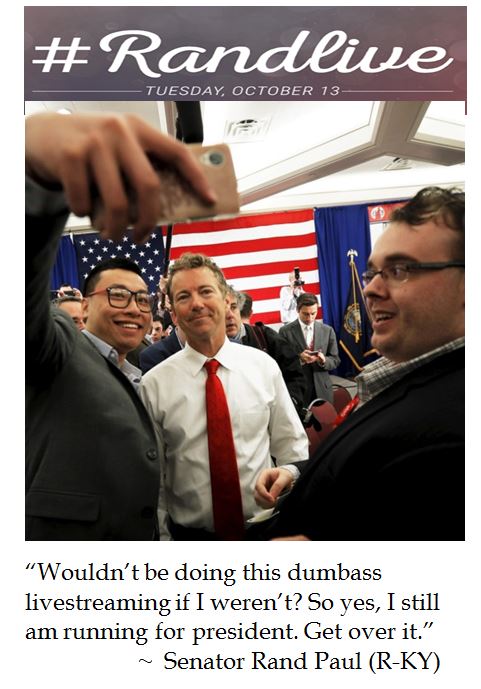
Geek Gaffes Mar #RandLive

Rand Paul on Livestream

One of the most precipitous declines in the race for the 2016 Republican Presidential nomination has been Senator Rand Paul (R-KY).  Last year, the libertarian leaning Senator Paul was considered to be a top contender.  But Paul’s campaign has faded to the point of where he may not have the 2.5% support to qualify for the big stage for the third GOP debate required by CNBC.

Senator Paul wanted to do something different to attract attention, generate enthusiasm among young voters and distinguish himself.  So the Paul campaign arranged for the candidate to LiveStream a day in the life.  This was a thrifty way to shine a spotlight on the candidate, leverage new media to political advantage and reinforce his brand of being a different kind of Republican.

Well, timing is everything. Tuesday October 13th was the date chosen for #RandLive.  From the superstitious side of things, the Spanish consider Martes el trece to be a day of bad luck (akin to America’s Friday the 13th).  On the more calculating side, that was the day of the first Democrat Debate so Rand was scheduling a stunt that would not draw a whole lot of attention.

Perhaps it was lucky that #RandLive did not get much time in the spotlight.  Senator Paul was scheduled to visit five college campus events in Iowa that day.  But technical difficulties interfered with much of the livestreaming, so diehard Rand-ians were left staring at a test pattern for much of the day.  These cyber glitches were unfortunate but not unforgivable as it is challenging to introduce new technology into the field of national political campaigns.

What was more egregious was Senator Paul’s unscripted answers to Google questions.  The third most popular question was “Are you still campaigning Senator Paul?”.  The freshman Senator from Kentucky gave a sarcastic and supercilious unscripted answer.


So much for appealing to the youth vote when you denounce the platform itself.  Moreover, calling it “dumbassed” shows that it was a feign and not really reflecting the candidate’s true disposition.

Other hopefuls used social media on that day to varying effects.  Both former Governor Mike Huckabee (R-AR) and Donald Trump live-tweeted during the Democrat Debate.  It looked like “the Huckster” slinged up cornpone and canned ham in his replies, while “the Donald” delivered authentic raw meat which underlined his attributes.

While it is questionable if hyping a “Truman Show” for a candidate is wise, it does show innovation.  But if you are on camera 24/7, one slight slip up can ruin years of work. In the film “The Truman Show” (1998), people found that they liked watching Truman because he was natural and likable.   Senator Paul has developed a reputation for being prickly in uncomfortable interviews.  It is telling that Senator Paul noted that you can’t edit that out when it’s being livestreamed.


The tag line from The Truman Show was “How's It Going to End?”.  This may well be the same question that staffers for Rand Paul’s Presidential campaign may be asking.   


Perhaps Senator Paul can take a cue from Truman Burbank. 


Wednesday, October 14, 2015

Contrasting Social Media Counterprogramming Strategies for the Democrat Debate


The Democrats held their first Primary "Debate" (more of a candidate forum) at a Las Vegas casino. Most political pundits expected a snoozefest which lays a foundation to a Primary Coronation.

So that Republicans did not totally cede the news cycle to a progressive politics lovefest, a couple of Republican aspirants to the Oval Office took to Twitter to counter-program by chiming in on the process. It was a cheap way to gain attention and get the message out, going over the heads of the established media through the new media.

Donald Trump made headlines with his announcement that he would live tweet the event.  Former Governor Mike Huckabee (R-AR) also wanted to get in on the action.  The latter leader's sharing seems to epitomize his campaign thus far--  cornpone slung just to win attention.

Take some of the @GovMikeHuckabee tweets--


They seemed like stale standbys to get some yucks. But unlike Huckabee's two debate performances when he dished out canned ham, it seems that the self nicknamed "Duck Hunter" did actually seem to watch the Democrat Debate.


That being said, Huckabee tried to be funny rather than to score points with his big campaign themes. 


In contrast, Donald Trump tried to steal the spotlight by starting with his star-appeal schtick thru @realDonaldTrump tweets--


Trump used social media to leverage his message by retweeting others who echoed or enhanced his memes and campaign messaging, whereas Huckabee basically used Twitter as a platform to share his pre-scripted one liners.


However, it looked like Donald Trump was genuinely reacting to the debate.  His social media responses reinforced his campaign messages on immigration, Washington is broken, helping Veterans and Hillary's hypocrisy.

One indication that Trump was not totally rehearsed in his responses is a short missive "Good move by Bernie S." that has no reference point, hash tags or even Twitter handles.  Presumably, this was when Senator Bernie Sanders (Socialist-VT) said: "Enough with the emails already!".

On the one hand, Trump generated excitement with his social media participation in the Democrat Debates with authenticity, branding and passively marketing his message. On the other hand, Huckabee served up more cornpone which were groaners to political pundits but did little to advance his own message via social media.

With the revised qualifications for the CNBC debate, this might be one of the last servings of cornpone and canned ham from the Huckster.